Platforms: PS3, PS4, Xbox 360, Xbox One, PC
Release Date: February 25, 2014

Despite being in the same franchise that arguably birthed the stealth genre back in 1998, this new reboot of Thief has no idea how to stay relevant.
Stealth games have seen many advancements over the years from games like Dishonored and Hitman: Absolution. The forward progress in hardware and design have also been key factors into making a golden handful of sneaking-based games that have been standouts in their years of release. Thief‘s new reboot, simply titled Thief, looks as though it wants to take back the spotlight it has relinquished in the past decade or so. Despite being a game about thievery, Thief can’t even steal the best aspects from its newfound competition.
Thief‘s worst offense is the claustrophobic level design. Think of a recently-released, critically-acclaimed stealth game. Splinter Cell: Blacklist, Metal Gear Solid V: Ground Zeroes, Hitman: Absolution, Dishonored, Deus Ex: Human Revolution, Mark of the Ninja and even games like Batman: Arkham City, Assassin’s Creed IV: Black Flag, and The Last of Us all have a few things in common. Each has open environments and allows the player to approach the situation however they please, which are both essential in designing a great stealth game.
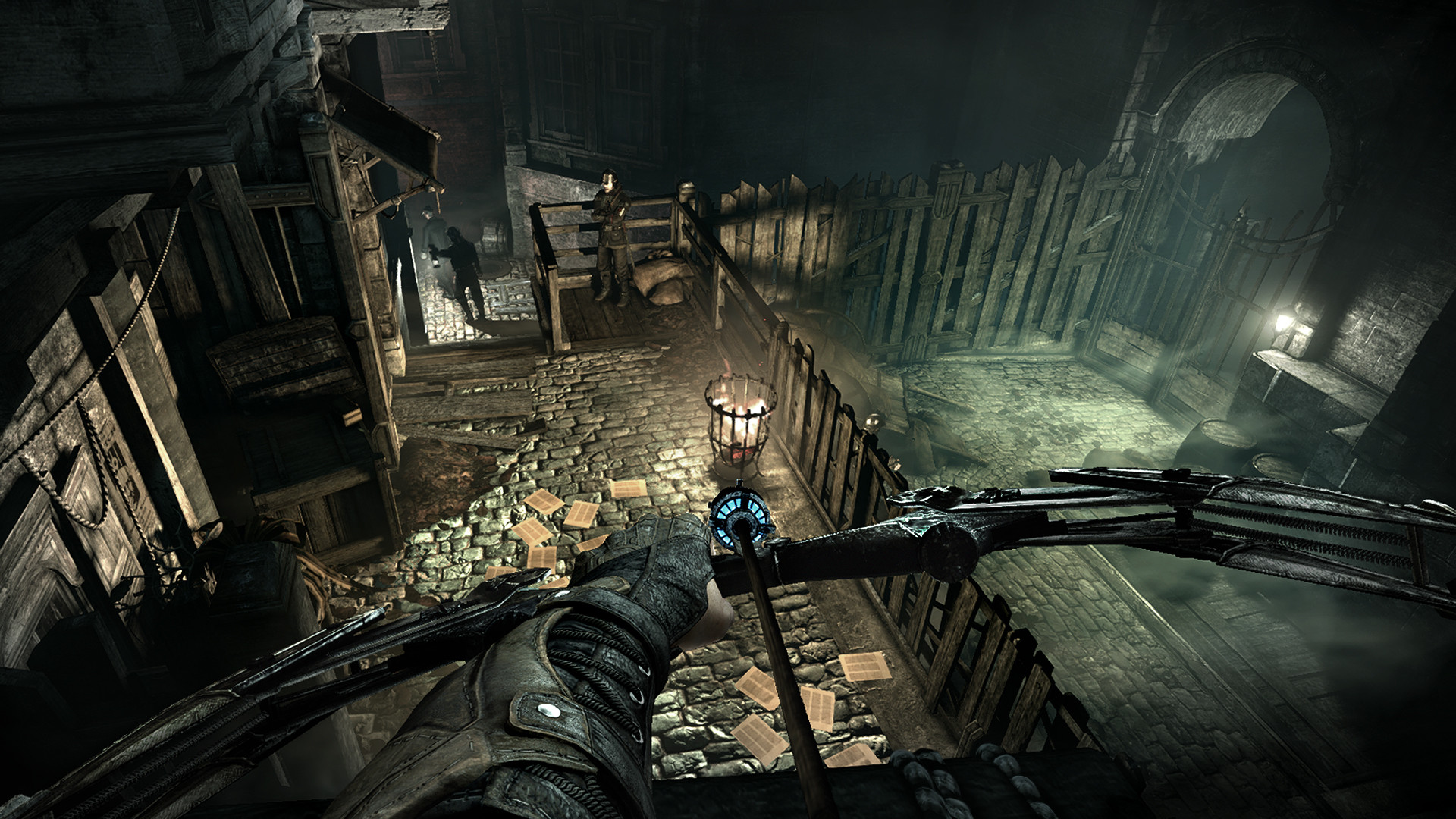
You usually have to shoot out fires because you can’t usually sneak around them.
Thief refuses to acknowledge either advancement, instead banking on incredibly narrow corridors for each level and barely giving you enough options to reach objectives. The few relatively open areas quickly funnel you into tight hallways that don’t yield many thieving options. This is problematic because sneaking by someone in a hallway can just feel like entrapment. Dead ends, which are the antithesis of open areas, are far too plentiful and sneaking past the moronic guards usually just relies on their terrible AI.
These dummies are usually locked to their specific post or they have routines that are etched in stone, but, no matter their patrol patterns, they all have horrendous eyesight. If you are in the shadows, you may as well be invisible. However, this is a backhanded compliment because narrow levels mixed in with intelligent enemies would only equal frustration. Stealth games can usually get away with some unrealistic AI, but here they all mix together to form an archaic game stuck in the early 2000s. It never feels like you are outsmarting the guards, rather, you’re just exploiting their poor intelligence.

This dumb guy is gonna get tickled so hard.
Dealing with guards is also pretty difficult because of the limited amount of tools and options given to the main character, Garrett. This shortcoming negatively impacts both the sneaking and traversal. Since you don’t possess many options outside of the bow, you can’t really manipulate the guards nor can you find alternate ways to infiltrate compounds because you just have the tools to do so. You can use the rope arrows to climb some structures and the screwdriver to lift grates, but these are rarely options, just the option.
Garrett can use different arrows but the non-lethal arrows are extremely rare (which is partly because the shop is so frustratingly difficult to find). This forced me to play lethally but, once caught, the woefully equipped and vastly underpowered Garrett has two options: run and hide or die. Arrows don’t load quickly enough to become an non-stealth weapon and the melee-focused Blackjack gives little more than a love tap to the guards. This effectively forces you to stick to the shadows and only stick to the shadows. When games like Dishonored can juggle combat and sneaking and make them both effective, something as myopic as Thief is extremely frustrating.

Did I leave the oven on? Nah.
Thief does sort of assemble some sort of groove, but it never maintains it for longer than a few minutes. Breaking into a place and lifting it of its treasures is a feeling the game should be all about. Sadly, this feeling only brings false hope because all of the other inconsistencies dash away any sense of master thievery. But at least it is there in some capacity.
While it should be in a better game, Thief‘s customizable difficulty should set a precedent for many games to come. It has the standard gamut of modes, but the final mode allows you to set your own restrictions. You can disable saves, takedowns, health pickups, and most of the other player-friendly options. Each gives a points to a multiplier that gives incredibly flexibility to your experience. It’s a shame that Thief isn’t a game that I want to play again, but this is a great move for other games to learn from in order to satiate the hardest of the hardcore.
Regardless of the difficulty, the story is the same and still laughably terrible. Garrett is on a heist with an old friend when it goes sideways, leaving her for dead and putting Garrett in a coma. When he wakes up, he has to piece together what happened and the mysterious beings behind it.

It’s good to see Ron Jeremy still getting work.
While not wholly original, the premise isn’t nearly as bad as its presentation. Garrett is fairly smooth but the bulletpoints of the plot are inconceivably bad. No face is memorable once they leave the screen and the paranormal left turn the story takes and sticks to is just plain awful. Bad stories can sometimes be ignored, but Thief‘s poor plot is one that constantly begs for attention and never makes good on it.
While Thief‘s dark environments look nice and detailed, the audio design isn’t up to the same standard. Whether they are two yards away or twenty, voices almost always sound like they are right behind you. This is particularly important in a stealth game where using audio to deduce enemy locations is a viable strategy. It’s off-putting, confusing, and only adds to the list of problems that have to do with the stealth mechanics.
I’ve never seen a game stick so stubbornly to old habits like Thief. Whether it was staying faithful to its ancient roots or just the victim to a hellish development cycle, Thief deserved better. Eidos Montreal has even shown us better in Deus Ex: Human Revolution, a game that shames Thief in every perceivable way. By not taking from others in the genre, Garrett is not a master thief; just a has-been dying a slow death.
Grand Heist
+Stealing feels smooth
+Environments, while dark, look sharp
+Customizable difficulty
Petty Thievery
-Extremely cramped level design that doesn’t allow choice
-Stupid enemies
-Terrible sound design
-Abysmal story
-Frequent loading

 Charge Attack